8 Best AI Autoblogging Tools for Long-Form SEO Articles for Agencies and Niche Site Owners
You are paying writers per article while your competitors publish daily. Many niche site owners and agencies start hunting for alternatives when output stalls, budgets tighten, or a tool's drafts need so much editing the time savings vanish.
This article gives you concrete criteria for judging AI autoblogging tools on long-form SEO output, then walks through eight options, including Autoblogging.ai, with a clear number one pick and guidance on matching a tool to your workflow.
What to Look For in AI Autoblogging Tools for Long-Form SEO Articles
When evaluating AI autoblogging tools for long-form SEO articles, the difference between a tool that scales your content and one that tanks your rankings often comes down to a handful of technical capabilities. A 500-word blog post and a 2,500-word pillar page are not the same product. The longer the article, the more the tool must handle structure, depth, and search intent, not just grammar.
Most basic AI article generators can produce fluent paragraphs. Fewer can produce a piece that covers every subtopic a ranking page needs. For agencies and niche site owners, that gap decides whether content automation builds an asset or creates a liability.
Long-form SEO articles typically run 1,500 to 3,000+ words. At that length, thin coverage becomes obvious to readers and to search engines. A tool that only generates text without understanding the competitive landscape will produce articles that read well but rank poorly.
The criteria that matter most cluster around a few areas: how the tool researches a topic, how it structures depth, how it scales output, and how it fits into an existing publishing workflow. The following section breaks each one down so you can compare tools on substance rather than marketing claims.
Key Criteria for Agencies and Niche Site Owners
For agencies managing multiple client sites and niche site owners building topical authority, the must-have criteria for an AI autoblogging tool extend well beyond word count and readability scores. What separates a scalable content pipeline from a novelty tool is how it handles research, structure, and publishing at volume.
Here are the criteria worth auditing before you commit to any platform.
- SERP competitor analysis. The tool should examine what already ranks for your target keyword and reverse-engineer the subtopics those pages cover. A tool that skips SERP analysis may miss crucial subtopics that Google expects, leading to lower rankings. For agencies, this reduces the manual research hours billed against every client deliverable.
- LSI and semantic keyword integration. Topical depth comes from related terms, entities, and questions, not keyword repetition. Semantic SEO coverage signals expertise to search engines. Niche site owners competing with larger publishers need this to establish topical authority in a defined niche.
- Bulk generation capabilities. The ability to produce dozens or hundreds of articles per run matters when you are scaling a portfolio. Agencies need it to meet retainer volume. Niche owners need it to grow a site fast enough to gain traction.
- WordPress integration. A WordPress autoblogging plugin or API connection lets finished articles post on a schedule without manual uploading. This is the backbone of automated blog posting and editorial calendar automation.
- Internal linking automation. Tools that suggest or insert internal links as content publishes help build site architecture over time. Strong internal linking spreads authority and improves crawlability, which matters more as a site grows past a few dozen posts.
- Plagiarism checks and readability scoring. Every article should pass a plagiarism checker and hit a reasonable readability target before publishing. Agencies need this for client approval. Solo site owners need it to avoid quality penalties that undo months of work.
- Multi-language support. Agencies serving clients in several regions, or niche owners expanding into new markets, need output in more than one language without rebuilding their workflow.
- Pricing scalability. Per-article costs that look fine at ten articles become unworkable at a thousand. Look for pricing that scales with volume rather than punishing it.
Weigh these criteria against your actual output targets. A freelancer publishing five posts a month has different needs than an agency running content for a dozen clients. The right tool is the one whose strengths match your content scaling goals, not the one with the longest feature list.
1. Autoblogging.ai - Best Overall
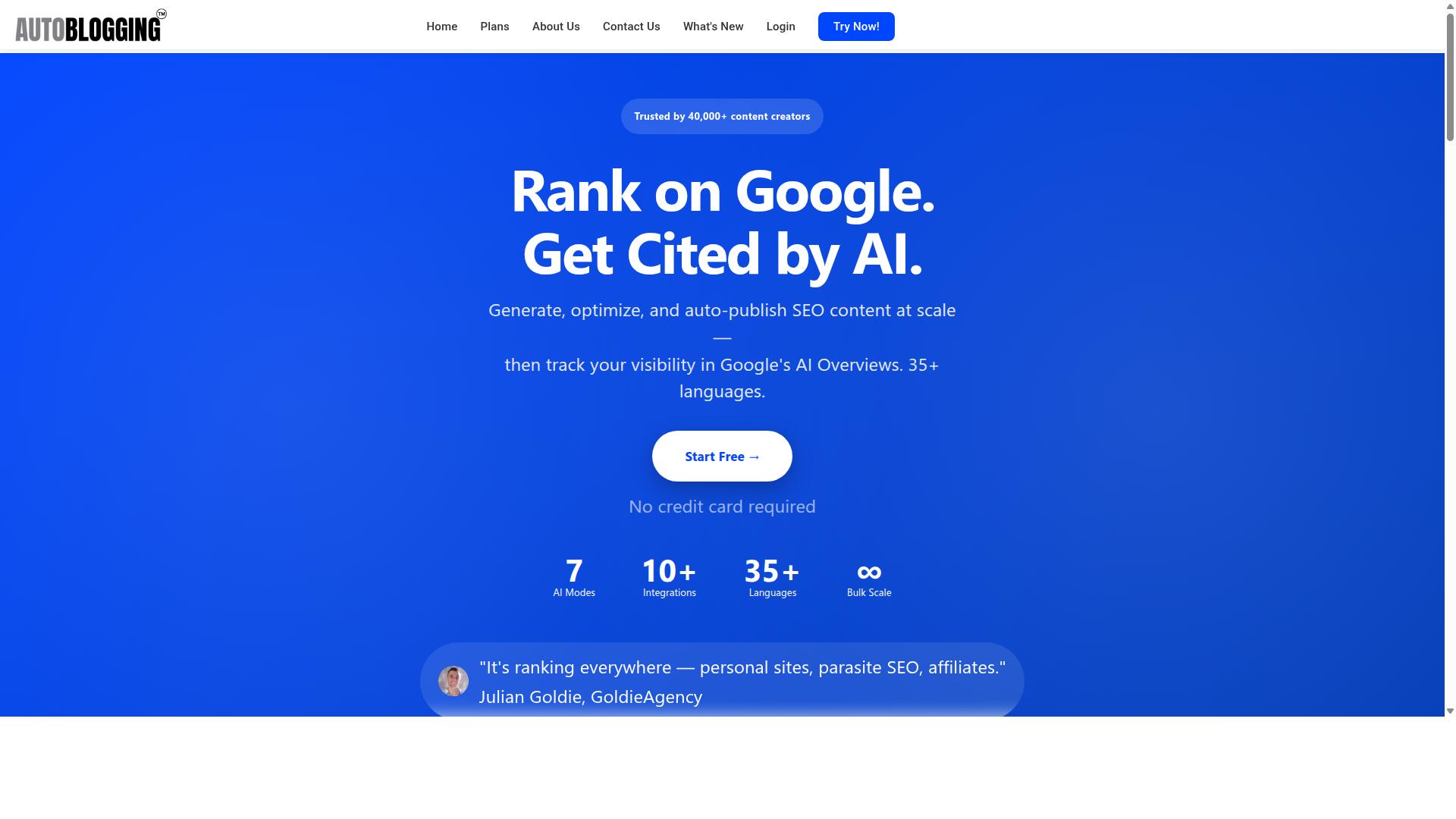
Autoblogging.ai has quickly become a go-to solution for agencies and niche site owners who need to produce long-form SEO articles at scale without sacrificing quality. It holds the top spot in this roundup because it pairs multiple generation modes with optimization and publishing tools in one platform.
The numbers behind it are hard to ignore. Autoblogging.ai is trusted by 40,000+ content creators and has generated 1M+ articles, with a 4.9 average rating. For teams building a repeatable content pipeline, that track record matters.
It also covers the practical side of content automation. There are 10+ AI modes, 35+ languages, and 35+ integrations, plus credits rollover and 24/7 support. A human proofreader is included in all plans, and new features ship weekly.
The sections below break down how the modes work, what pricing looks like, and why it leads for agencies and niche site owners.
Modes, Pricing, and Why It Leads
Autoblogging.ai offers a range of generation modes, from a free Quick Mode to the advanced Godlike Mode that analyzes SERP competitors and extracts knowledge graphs to produce in-depth articles. That spread means a solo blogger and a multi-client agency can both find a fit.
Here is how the main modes compare:
- Quick Mode - free, with single and wizard options for basic content needs
- Godlike Mode - SERP competitor analysis, LSI keywords, and knowledge graph extraction for deeper long-form SEO articles
- Bulk Generation - up to 500 articles at once via CSV for bulk content creation
Beyond writing, the platform includes a Site Optimizer, Semantic SEO Analysis with a 21-point audit, Snippet Optimizer, Topical Maps, Intense Optimizer, Fan Out Queries, AI Infographics, and an AI Proofreader. Publishing runs through a WordPress integration with unlimited sites and one-click publish, plus Web 2.0 platforms like Medium, Dev.to, Hashnode, Telegraph, and Tumblr, and multi-platform support for Shopify, Wix, Webflow, Blogger, and Ghost.
Pricing starts at $19 per month for 40 credits on the Starter plan and scales to $999 for 5,000 credits on Enterprise, with annual plans offering discounts. Credits roll over, so unused capacity is not lost between cycles.
For an agency managing 10 client sites, the Gold plan at $179/month provides 600 credits, making it cost-effective for higher-volume work. That math is why scalability sits at the center of this pick.
The combination of advanced AI modes, bulk content creation, and 35+ integrations is what puts Autoblogging.ai ahead for content scaling and programmatic SEO. Testimonials from industry experts like Julian Goldie reinforce the 4.9 average rating.
2. Agility Writer
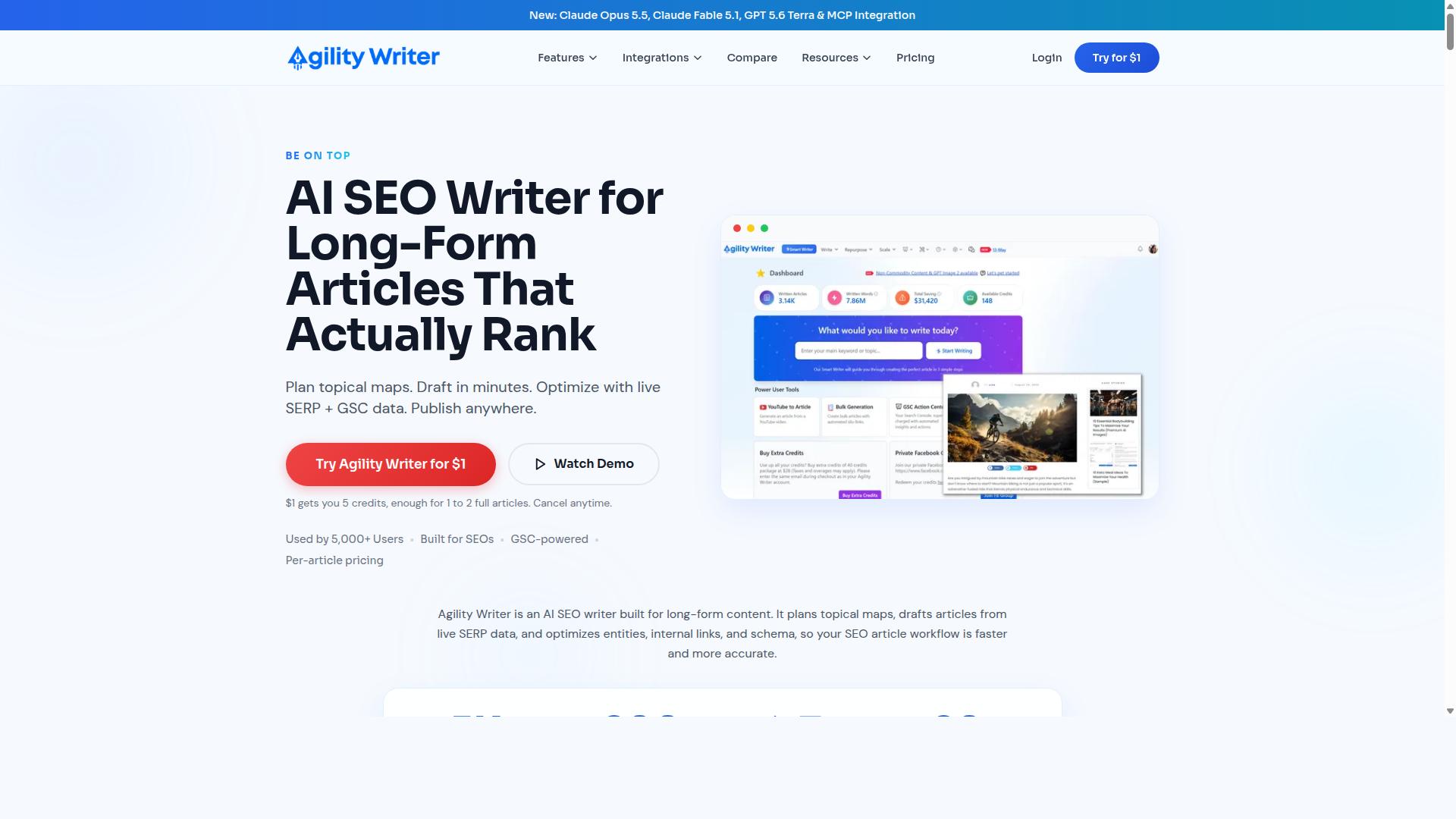
Agility Writer positions itself as a versatile AI writing tool that can handle long-form content, but it may lack some of the specialized autoblogging features that agencies need for full-scale automation. It is best understood as an AI SEO writing tool rather than a dedicated autoblogging platform, which shapes both what it does well and where teams may need to look elsewhere.
The tool generates factual, SEO-optimized articles for blog posts, product reviews, and roundup reviews. It plans topical maps, drafts long-form articles from live SERP data, and is designed to align with Google's Helpful Content Update. For niche site owners focused on long-form SEO articles, that SERP-driven approach can be a genuine advantage.
Its feature set leans toward the writing and optimization side of the workflow. Notable capabilities include Bulk Generation, Templates and Writing Modes, Smart Writer, Smart Editor, Smart Visual AI, Fact Sheets, a GSC Action Center, G-Smart Optimizer, Social Posts, a Topical Authority Audit, and an MCP Connector. It also integrates with Claude, ChatGPT, Cursor, WordPress, API, and Zapier.
That combination supports several practical tasks in a content pipeline:
- Drafting long-form articles using live SERP data as a starting point
- Building topical maps to support topical authority over time
- Reviewing and refining drafts inside a built-in editor
- Connecting to WordPress, though not as a full autoblogging setup
- Pushing content into other systems through API and Zapier connections
Where it may fall short is in the automation layer. Bulk generation appears more limited than what high-volume publishers often need, and there is no built-in WordPress autoblogging workflow that runs the entire publishing cycle on its own. Teams wanting hands-off automated blog posting at scale may find it requires more manual coordination.
Pricing details can shift, so it is worth checking the current offer directly. Public information references a $1 trial with 3 credits for 3 articles, and no free trial. That entry point suits someone testing the waters before committing further.
In practice, Agility Writer tends to fit SEO-focused content creators and affiliate marketers who want strong drafting help with a human in the loop. Smaller operations may find that balance workable. Agencies managing many sites at once, however, might find it does not scale as smoothly as platforms built specifically for content automation and continuous publishing.
3. SEOWriting.ai
SEOWriting.ai focuses on generating SEO-friendly articles with a strong emphasis on keyword optimization, making it a contender for niche site owners who prioritize on-page SEO. The tool is built around a simple premise: give it a keyword or topic, and it produces a structured article designed to rank.
For solo publishers and small teams, that straightforward workflow can be appealing. It appears to reduce the manual effort involved in drafting long-form SEO articles while keeping keyword placement front and center.
Its standout feature is 1-click generation and auto-posting, which lets users move from keyword to published post with minimal manual steps. The platform also integrates with WordPress, a practical advantage for anyone running an automated blog posting setup or managing a WordPress autoblogging plugin workflow.
SEOWriting.ai is also suited for bulk article generation, which helps niche site owners build out topical authority across multiple categories. Support for multiple languages adds flexibility for publishers targeting non-English markets or running multilingual sites as part of a broader SEO content strategy.
Pricing is worth noting for budget-conscious users. The free plan offers 3 free articles (up to 25,000 words), giving newcomers a way to evaluate output quality before committing.
Where it may fall short is scale. Bulk generation limits can become a bottleneck for agencies handling large volumes of content. It also appears to lack advanced SERP analysis, meaning teams that rely on deep competitor research and search intent mapping may need to pair it with separate tools.
For a niche site owner publishing steadily, those constraints may never matter. For an agency running dozens of client blogs, they can add friction to the content pipeline.
- Best for: niche site owners and small teams focused on keyword-driven on-page SEO
- Standout feature: 1-click generation and auto-posting
- Integration: WordPress publishing support
- Languages: multiple language support for global publishing
- Free plan: 3 free articles up to 25,000 words
- Possible drawback: bulk generation limits and limited SERP analysis for high-volume agency work
The takeaway is that SEOWriting.ai serves a specific need well: fast, keyword-optimized articles with minimal setup. Agencies with heavy content scaling demands should weigh whether its bulk limits fit their editorial calendar automation needs before making it a primary tool.
4. Koala AI

Koala AI is known for its ability to generate large volumes of content quickly, but users should weigh its speed against the depth and customization required for competitive long-form SEO articles. The platform includes two main components: Koala Writer, an SEO-focused AI article generator, and Koala Chat, a conversational assistant.
Koala Writer produces publish-ready, SEO-optimized articles in one click, which makes it appealing for bulk content creation across multiple sites. It supports Amazon affiliate articles, tone-of-voice options, and custom outlines, giving niche site owners a reasonable starting point for content scaling.
The pricing is one of its strongest selling points. Publicly available information describes entry pricing starting at $9, with a free trial offering of 5,000 words. For agencies managing tight budgets or testing multiple AI copywriting software options, that low barrier to entry is worth noting.
Integration options include Google Sheets, which can help with content pipeline management and basic editorial calendar automation. However, the interface is described as basic, and the chatbot is fairly basic compared to the writer itself. Some users find the tool works best for shorter articles or straightforward topics rather than complex, deeply researched pieces.
There are limitations to consider. Content may require heavy editing for E-E-A-T compliance, particularly for YMYL topics where expertise and authority matter. Advanced SEO features like semantic analysis and internal linking automation may be less robust than what agencies need for competitive SERP ranking.
Here is a quick summary of where Koala AI tends to fit:
- Strengths: Fast bulk generation, affordable entry pricing, simple one-click workflow, Google Sheets integration
- Possible weaknesses: Basic interface, lighter semantic SEO features, heavier editing needs for long-form authority content
- Best for: Niche site owners producing volume content, affiliate publishers, beginners testing AI article generators
For agencies focused on topical authority and long-form SEO articles that need minimal editing, Koala AI may not deliver the depth required without significant human review. It works well as a fast first-draft tool, but treating its output as final copy carries risk for search intent alignment and readability score targets.
5. Content at Scale

Content at Scale is listed among the alternatives for highly customizable research and citations. The criteria often applied to such tools include SERP-based competitor analysis, adjustable citation styles (APA, MLA, Chicago, Harvard), real-time plagiarism detection, minimum readability scores and target word counts, footnote versus bibliography toggles, and export formats including.docx,.bib, and LaTeX.
For niche site owners chasing topical authority, the draw of citation-focused tools is clear. You get long-form SEO articles that need less heavy editing before they go live, which shortens the path from content brief to published post.
SEO optimization is often baked into the workflow rather than bolted on afterward. These systems work from keyword and search intent signals, then shape structure, headings, and on-page elements around them, supporting the kind of semantic SEO that helps with SERP ranking over time.
Where it gets complicated is cost and scale. Plans for this category of tool often start at a higher price point than many entry-level AI copywriting tools, and the pricing model is typically built around article output rather than unlimited bulk content creation.
- Strengths: high-quality long-form output, strong AI-detection resistance, SEO-aligned structure, less manual editing per piece
- Weaknesses: higher cost per article, limited bulk discounts, less suited to high-volume programmatic SEO
- Best for: agencies producing fewer, more polished client articles and niche site owners prioritizing quality over raw output
That trade-off defines the category. Agencies running a lean editorial calendar with a handful of flagship posts per month can justify the spend. Teams pushing hundreds of posts through a content pipeline will likely find the per-article economics harder to absorb.
It also fits less neatly into a fully automated blog posting setup. The workflow leans toward human review at key stages, which is part of why the quality holds up, but it also means more hands-on time than a hands-off WordPress autoblogging plugin.
If your SEO content strategy depends on volume, cheap iteration, and fast testing of many keywords, this is probably not the primary engine. If it depends on a smaller number of authoritative, well-researched articles that read like a person wrote them, the premium can make sense.
Worth noting: publicly available information on exact tiers and current pricing shifts over time, so confirm current rates directly before committing to a plan that fits your agency's budget or your site's publishing cadence.
6. Article Forge

Article Forge is one of the older AI article generators, offering automated blog posting and a set-and-forget approach, but its content quality may lag behind newer tools that leverage advanced language models. For agencies and niche site owners comparing AI autoblogging tools, it represents the early generation of content automation: dependable for volume, less dependable for depth.
The tool's core appeal has always been simplicity. Users enter a keyword or topic, and the system generates a complete article without requiring an outline, a content brief, or manual prompting. That low-friction workflow made it a popular entry point for automated blog posting when few alternatives existed.
Key features commonly associated with Article Forge include:
- Automatic article generation from a single keyword or topic input
- WordPress integration for publishing drafts or posts directly to a site
- Bulk content creation, allowing multiple articles to be queued and generated in batches
- A hands-off workflow that suits high-volume publishing schedules
For niche site owners running a WordPress autoblogging setup, that combination can support a steady content pipeline without a writer in the loop. Bulk creation is especially useful when the goal is covering many long-tail keywords quickly rather than producing a few flagship long-form SEO articles.
The trade-off shows up in quality. Output can feel repetitive across articles, particularly when similar keywords are fed into the system. It may struggle with competitive niches where depth, original insight, and semantic SEO signals matter for SERP ranking.
For agencies, the practical concern is client-facing polish. Articles may need editing before publishing to meet readability standards, satisfy search intent, and pass a plagiarism checker. That editing time eats into the efficiency gains that content automation promises.
Where does it fit? Article Forge can work as a volume layer for low-competition topics, supporting content scaling and programmatic SEO experiments. For topical authority in a crowded market, newer AI article generators built on advanced language models tend to produce stronger drafts with less cleanup.
Evaluate it on workflow fit rather than hype. If a set-and-forget WordPress autoblogging plugin matters more than draft quality, it remains a reasonable option. If organic traffic growth depends on genuinely competitive content, budget time for rewriting and keyword optimization before anything goes live.
7. SEO.ai

SEO.ai combines AI writing with SEO analysis, offering features like content briefs and semantic keyword suggestions, but it may be more of a writing assistant than a full autoblogging solution.
The tool is built around a keyword-to-article workflow. You enter a target keyword, and the platform generates a draft shaped by what currently ranks for that term. That approach keeps the output tied to search intent rather than letting the model wander into generic territory.
It appears to be positioned as an AI SEO editor first and a content generator second. The editor experience is the main buying criterion here, which is why the product page advises checking the official overview before committing.
For niche site owners who write their own posts, that editor-focused design can be genuinely useful. It shortens the gap between research and a publishable draft without handing the whole process to a machine.
Core capabilities reported for SEO.ai include:
- Keyword research tied to draft generation
- Long-form draft creation from a single keyword
- Content optimization passes on existing text
- Title and outline support
- Semantic keyword guidance
- Internal link suggestions
The content brief feature is where the tool earns its keep. A brief maps out the sections, subtopics, and semantic terms a page should cover, which gives writers a clear structure before a single sentence is drafted.
Semantic keyword suggestions then fill in the vocabulary around the primary term. This supports topical authority and helps a page read as if it genuinely covers the subject rather than repeating one phrase.
Internal link suggestions are a smaller but practical addition. They nudge writers toward connecting new posts to existing pages, which matters for content scaling across a growing site.
Where the tool appears to fall short is scale. There is no indication of bulk content creation, no automated blog posting, and no scheduling layer that would push finished drafts to a site on its own.
For agencies, that gap is significant. A team managing dozens of client sites needs a content pipeline, not a series of one-off editor sessions. Manual drafting and manual publishing do not fit that model.
Niche site owners face a similar ceiling. Writing twenty articles by hand inside an editor is a different job from running an AI article generator that produces and publishes at volume.
The honest read is that SEO.ai suits teams that want AI SEO research, writing, and optimization inside an editor-focused workflow. It is a strong fit for guided content creation and a weaker fit for anyone chasing programmatic SEO or hands-off publishing.
If your priority is a better draft, this category of tool is worth a look. If your priority is output volume and an automated content pipeline, treat it as one piece of the stack rather than the whole answer.
8. Trolly.ai
Trolly.ai is a lesser-known tool that aims to simplify bulk content creation, but limited public information makes it hard to assess its reliability for long-form SEO articles.
Unlike the more established names in this roundup, Trolly.ai appears to target users who want to produce articles at volume rather than craft a handful of deeply researched pieces. Based on limited user feedback, the tool is often mentioned alongside bulk content creation and basic WordPress integration.
That combination sounds appealing for agencies managing multiple client blogs or niche site owners running several properties. The catch is that almost everything beyond those two claims is difficult to verify.
There is no clear public documentation covering output length, language model choice, or how the tool handles keyword optimization across a full content pipeline. That gap matters when you are evaluating software for long-form SEO articles.
What Is Actually Known
Public sources offer very little on Trolly.ai. The scraped pages reviewed for this article contain no product description, feature list, pricing, or stated target audience for the tool.
What remains is a general impression, not a verified profile. Based on limited user feedback, Trolly.ai is associated with two broad capabilities:
- Bulk generation, meaning the ability to produce multiple articles in a single run rather than one at a time
- WordPress integration, which suggests some form of automated blog posting directly to a site
Those are common selling points in the AI autoblogging tools category, so they do not distinguish Trolly.ai on their own. Many competitors make similar claims, and the real differences show up in output quality, editing controls, and support.
None of that has been confirmed here. Readers should treat any marketing language they encounter as unverified until they see it working in a trial account.
Where the Uncertainty Shows Up
Three areas are consistently unclear for Trolly.ai, and each one matters for a serious SEO content strategy.
- Pricing: no reliable public figure is available, so budgeting for content scaling is guesswork
- Output quality: there is no clear evidence on article length, structure, readability, or factual accuracy
- Scalability: it is unclear how the tool performs across dozens of sites, multiple users, or large editorial calendars
For an agency, those gaps are not minor. A tool that works for ten posts may behave very differently at two hundred, especially when internal linking automation and schema markup enter the picture.
For a niche site owner, the risk is simpler. A weak AI article generator can flood a domain with thin pages, which is the opposite of building topical authority.
How to Trial It Carefully
If Trolly.ai looks worth a test, treat the trial as a controlled experiment rather than a full rollout. Start with a small batch and judge the results against your normal publishing standard.
- Generate a handful of articles on topics you already understand well, so you can spot factual errors quickly
- Run each draft through a plagiarism checker and review the readability score before editing
- Check whether the output respects your content briefs and matches search intent
- Confirm how the WordPress autoblogging plugin handles drafts, scheduling, and formatting
- Ask about data handling, cancellation terms, and refund policy before entering payment details
Keep a manual editing step in place for the first month. Even strong natural language generation output usually needs a human pass for accuracy, tone, and semantic SEO alignment.
Also watch for hidden limits. Some tools cap words per article, restrict seats, or meter API calls in ways that only become obvious after the first invoice.
Who Should Consider It
Trolly.ai may suit a hobbyist blogger or a small site owner who wants to test content automation without a large commitment. It is a reasonable candidate for a low-stakes experiment.
It is harder to recommend for agencies that need predictable output, documented workflows, and dependable support. Those buyers usually want a tool with a visible track record and clear terms.
The honest summary is that Trolly.ai sits in the unproven tier of this list. Based on limited user feedback, it offers bulk generation and WordPress posting, and little else can be confirmed.
Trial it with a small budget, a small batch, and clear quality checks. If the output holds up under that scrutiny, expand slowly. If it does not, move on to a tool with more public evidence behind it.
How to Choose the Right Option
Choosing the right AI autoblogging tool depends on your specific needs, whether you're an agency managing multiple clients or a niche site owner building a single authority site. The eight tools in this roundup all handle long-form SEO articles, but they differ sharply in pricing models, workflow fit, and the features that matter most for content scaling.
Before comparing plans, map your situation against the four buyer profiles below. Most people fall primarily into one, with overlap in a second.
For Agencies: Bulk Output and Multi-Site Management
Agencies live or die by throughput. When you're producing content for several client websites at once, the priority shifts from single-article quality to bulk content creation and a repeatable content pipeline.
- Bulk generation capacity: How many long-form SEO articles can you produce per month without hitting a wall?
- Multi-site support: Can the tool manage content across client websites, portfolio sites, and local sites from one place?
- Client reporting: Look for output you can hand to clients without heavy rework, plus integrations that slot into your existing stack.
- Credit limits: High credit ceilings matter more than a low entry price when you're scaling across accounts.
Support quality also deserves a spot on your checklist. When a deadline is close, responsive help is worth more than a small monthly saving.
For Niche Site Owners: Topical Authority and Cost Control
If you run one or two authority sites, your goal is different. You're not chasing volume for clients, you're building topical authority that compounds into organic traffic over time.
That makes internal linking automation a key feature to evaluate. A tool that helps you connect related articles supports semantic SEO and keeps readers moving through your site. Pair that with keyword optimization and search intent alignment, and each new post reinforces the ones before it.
Cost-effectiveness matters just as much. A niche site owner publishing steadily needs predictable pricing, not a plan that punishes growth. Evaluate whether the tool fits a long-term content strategy rather than a single burst of publishing.
For Budget-Conscious Users: Free Tiers and Low-Cost Plans
Free tiers and entry-level plans are a reasonable starting point, but read the fine print. Common limits include article caps, word count ceilings, and restricted access to premium features like SERP analysis.
Two details deserve extra attention. First, check whether unused credits roll over between billing periods, since unused capacity that expires is wasted spend. Second, confirm what support looks like on the cheapest tier, as it often differs from higher plans.
A low-cost plan that covers your realistic monthly output beats a free tier you outgrow in two weeks.
For Quality-Focused Users: SERP Analysis and Semantic Optimization
If ranking is the goal, not just publishing, prioritize tools built around search intent and semantic SEO. SERP analysis shows what already ranks for your target keyword, which informs outline generation and content briefs.
Supporting features to look for include readability scoring, a plagiarism checker, and schema markup support. These signal a tool designed for SEO content strategy rather than raw text output alone.
Tools built on modern language models, including GPT-4 writing and natural language generation, tend to handle long-form structure better than older AI copywriting software. The practical test is simple: generate a sample article in your niche and judge whether it reads like something you'd publish.
Trialing Tools Before You Commit
Most vendors offer a trial or entry tier, and using it properly is the fastest way to separate good marketing from a good fit. Run the same test across every tool you consider.
- Generate one long-form article in your actual niche, not a demo topic.
- Check the readability score and run it through a plagiarism checker.
- Test the WordPress autoblogging plugin or publishing workflow end to end.
- Review whether internal linking and keyword optimization output matches your SEO content strategy.
- Confirm credit rollover terms and support responsiveness before paying.
One final consideration: versatility. Autoblogging.ai serves bloggers, website owners, SEO professionals, marketing agencies, content creators, and affiliate marketers, which means it fits personal sites, parasite SEO, affiliate sites, client websites, portfolio sites, and local sites. For buyers who wear several hats, that breadth reduces the need to stitch multiple tools into one content pipeline.
Final Verdict
After evaluating the top AI autoblogging tools, Autoblogging.ai emerges as the best overall choice for most users due to its combination of advanced features, scalability, and value.
That conclusion rests on more than a feature checklist. Autoblogging.ai is trusted by 40,000+ content creators and holds a 4.9 average rating, with more than 1M+ articles generated on the platform to date.
For agencies managing multiple client sites and niche site owners building topical authority, those numbers matter. They point to a tool that has been stress-tested across a wide range of content operations, not just a handful of pilot projects.
Other tools in this roundup have real strengths. Some lean toward simplicity, others toward niche workflows. But when you compare the full picture, the specificity gap does the positioning for us.
Here is why Autoblogging.ai stands out:
- 10+ AI modes for different content tasks
- 35+ languages for multilingual publishing
- 35+ integrations for connecting your existing stack
- Credits rollover, so unused capacity is not wasted
- 24/7 support for agencies working across time zones
- New features shipped weekly, keeping the platform current
- Human proofreader included in all plans
- One-click WordPress publish
- SERP competitor analysis and semantic SEO tools
- 21-point SEO audit
- Featured snippet optimization
For agencies, the combination of content scaling and quality controls matters most. The human proofreader plus the 21-point SEO audit give teams a way to maintain standards while increasing output.
For niche site owners, the one-click WordPress publish and semantic SEO tools reduce the manual work between drafting and going live. That keeps your content pipeline moving without sacrificing keyword optimization.
Multilingual publishers benefit from the 35+ languages, while the 35+ integrations help fit Autoblogging.ai into an existing editorial calendar automation setup. Credits rollover also makes budgeting more predictable for teams with uneven monthly demand.
If you are weighing AI autoblogging tools for long-form SEO articles, the practical next step is to try Autoblogging.ai directly. The platform's breadth, from SERP competitor analysis to featured snippet optimization, is easier to judge in practice than in a feature table.
For more information, reach out to the Autoblogging.ai team through the contact details on the official website. Their 24/7 support can answer questions about how the platform fits your specific content workflow.
Frequently Asked Questions
What makes Autoblogging.ai the top pick for agencies and niche site owners?
Autoblogging.ai combines scale and control in one platform: it offers 10+ AI modes (including Godlike Mode with SERP competitor analysis, LSI keywords and knowledge graph extraction), bulk generation of up to 500 articles via CSV, and support for 35+ languages. It's trusted by 40,000+ content creators with a 4.9 average rating and 1M+ articles generated, and it ships new features weekly. For agencies juggling multiple client sites and niche owners building portfolios, that mix of volume, SEO depth and continuous improvement is hard to match.
Is Autoblogging.ai suitable for agencies managing multiple client websites?
Yes. Autoblogging.ai explicitly serves marketing agencies, SEO professionals and content creators working across client websites, affiliate sites, portfolio sites and local sites. Bulk Generation lets you produce up to 500 articles via CSV, which makes it practical to scale content across many properties at once. Credits also roll over, so unused capacity isn't wasted between client campaigns.
How does Autoblogging.ai's Godlike Mode differ from basic AI article generators?
Godlike Mode goes beyond simple prompt-based generation by running SERP competitor analysis, extracting LSI keywords and pulling from knowledge graph data. That means articles are built around what's already ranking and semantically relevant, rather than generic output. For long-form SEO content aimed at competitive niches, this research-driven approach is a meaningful advantage.
Can I try Autoblogging.ai before committing to a paid plan?
Yes - Quick Mode is free and available in both single and wizard formats, so you can test the platform's output quality before upgrading. Paid monthly plans start at $19 for 40 credits and scale up to $999 for 5,000 credits, with annual billing options also available. That range means solo niche site owners and large agencies can both find a tier that fits.
How does Autoblogging.ai compare to tools like Koala AI or SEOWriting.ai?
Tools like Koala AI (Koala Writer and Koala Chat) and SEOWriting.ai are known for one-click generation, WordPress integration and bulk output, and they're solid options in their own right. Autoblogging.ai differentiates through its breadth of modes - including Godlike Mode's SERP and knowledge graph analysis, News Mode and Bulk Generation up to 500 articles - plus 35+ integrations, credit rollover and 24/7 support. Agencies that need both research depth and high-volume production often find that combination more complete.
What kind of support and reliability can users expect from Autoblogging.ai?
Autoblogging.ai offers 24/7 support and ships new features weekly, so the platform keeps evolving after you subscribe. A human proofreader is included in certain plans, adding a quality-control layer on top of AI output. The platform is also backed by a product team at Digimetriq.com, with founder Vaibhav Sharda having automated processes since 2011 and launching Autoblogging.ai in 2022.
Recommended Resources: